Archery
Saddle Hip Saver GoPro + MagSafe
Tree Saddle Bridge Spreader with 2-Prong GoPro Mount and Magnetic Phone Dock
$74.99
Out of stock
- $20+ ships free
- 30-day returns
- Lifetime warranty
The Saddle Hip Saver: Bridge Rope Spreader for Tree Saddle Hunters line · 2 models
View the line-
Classic
-
Hip Saver MagSafe
Viewing
The Detail Work
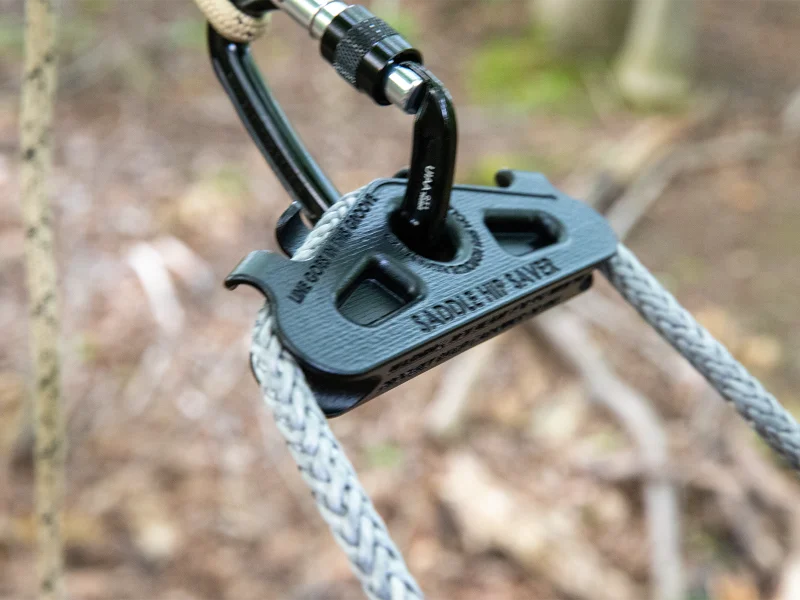
Installs at the carabiner, where your tether meets your bridge rope, and holds both bridge legs 4.53 in. (115 mm) apart so they stop pinching your hips, with a magnetic phone dock and 2-prong camera mount in the same spot. Rope-retention ears keep it on the rope through slack, and a post-process finish leaves the channel slick, so the rope glides and the carabiner rides quiet. 3.15 oz (89.2 g) assembled.
- The retention ears close on the bridge rope, not just the hardware around it. That is the difference between a mount that stays where you set it and one that swings loose the moment the bridge goes slack. Your spreader and your camera hold their position on the rope through standing, leaning, and settling back in.
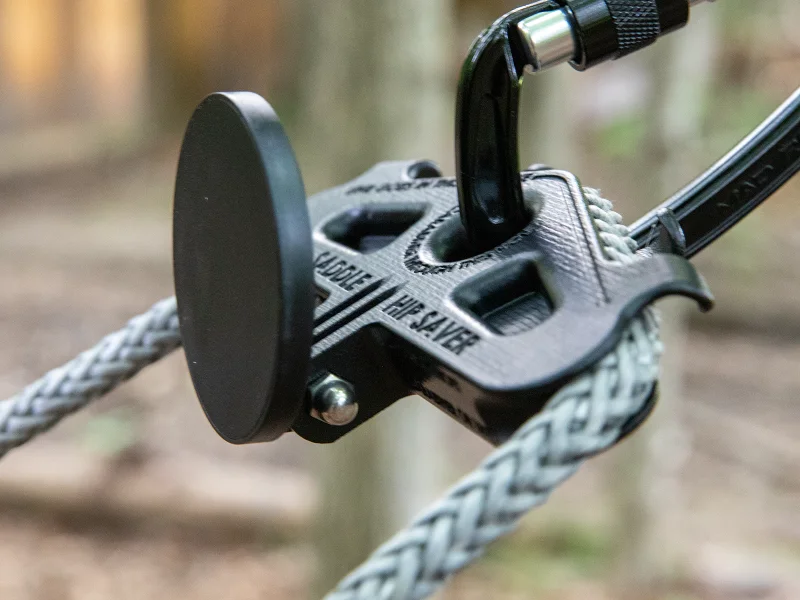
The Ears Hold It to the Rope
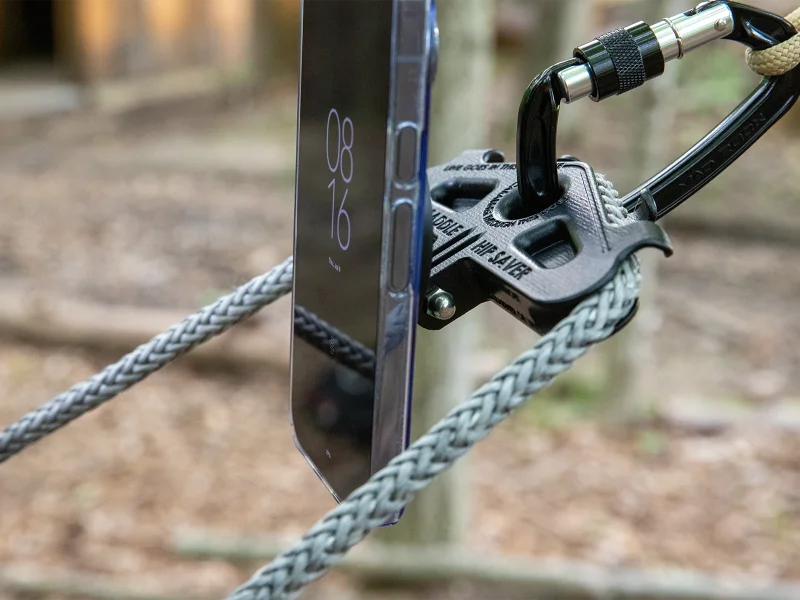
The bridge rope seats into the retention ears and they grip the spreader to it. Stand up on the platform, let slack into the bridge, and it is still at the tether junction when you sit back down and load the rope again.
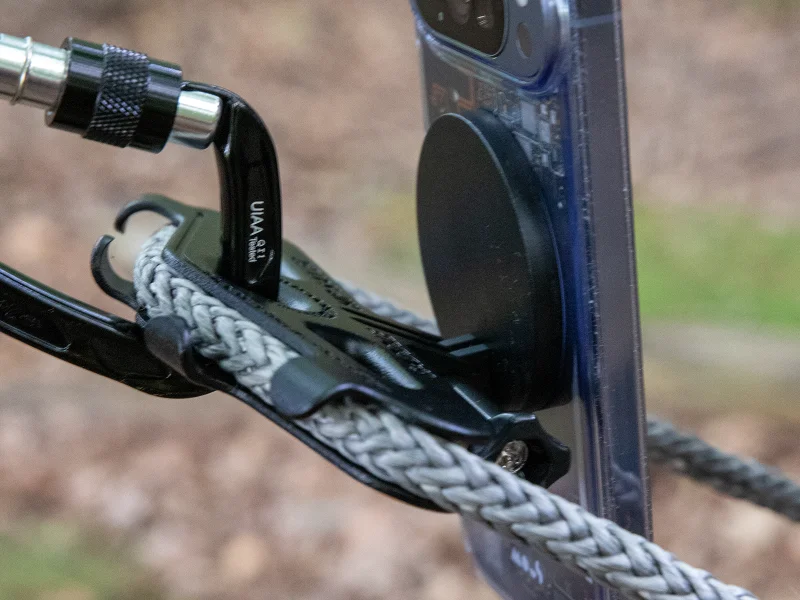
Magnetic Dock, Honestly Rated
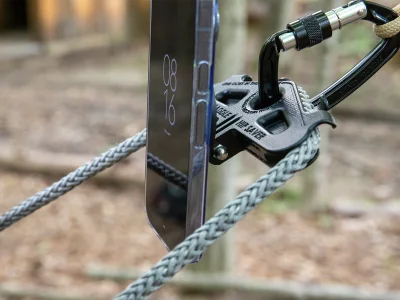
Snap a MagSafe or Qi2 magnetic phone on with gloves and rotate it between portrait and landscape. A thin magnetic case or no case holds best. A thick case, or one with no magnet ring, holds worst. Run a phone leash either way.
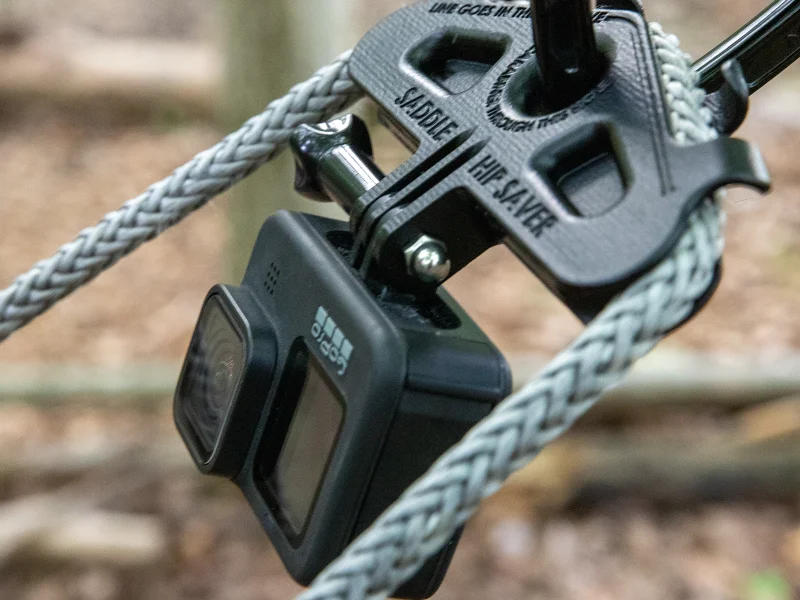
2-Prong Camera Mount Built In
The 2-prong mount takes a GoPro, an Insta360, or any standard 2-prong action camera on the included screw, so the footage that has to survive rough movement is held mechanically instead of magnetically. It sits tight to the body and stays clear of bark and webbing.
In The Field
Saddle Hip Saver GoPro + MagSafe - Comfort, Security, and Hands-Free Filming
All the load-spreading comfort and rope-retention ears of the Hip Saver, plus a built-in GoPro and MagSafe mount so you can capture the shot straight from the saddle. One clip does the hip work and the camera work.
Spec Sheet
- Material
- Nylon-12
- Weight
- 90 g
- Length
- 5 inch
- Width
- 0.87 inch
- Height
- 2.87 inch
- Compatibility
- GoPro, Insta360, 2-prong action cameras, MagSafe-compatible phones (iPhone 12+, Pixel 10+, any Qi2 or magnetic case).
Field Manual
Fitment first — everything you need to confirm this product works for you before you buy.
How well does the magnetic plate actually hold my phone in the tree?
It is a magnet, and what decides the hold is your case, not the plate. A bare MagSafe phone, a thin MagSafe case, or a Qi2 magnetic case holds noticeably better than a thick rugged case with no magnet ring in it, because a thick case pushes the magnets further apart and a case without magnets gives them nothing to grab. Run a magnetic-compatible case or no case at all and you will get the hold the plate is capable of. We are not going to tell you a phone cannot come off, because it can, and in the tree the usual way it happens is not the mount letting go on its own, it is a bump: turning in the saddle, brushing the trunk, catching it with a sleeve. Do what you would do with anything else you do not want to drop from 20 ft. (6.1 m) and run a short leash or lanyard from your phone to your bridge or saddle, so a knock leaves it hanging instead of on the ground. If the footage has to survive rough movement, put an action camera in the 2-prong mount instead, because a thumb screw through the prongs holds mechanically and a magnet does not.
Where does this actually install, and does it touch me?
It installs up at the carabiner, at the junction where the tether coming off the tree meets your bridge rope. It never touches your body. A saddle is a small hammock you wear, with a bridge line connecting at each hip and both legs of that bridge running up to meet at one carabiner. Left alone, those two legs converge into a narrow V above you, and that convergence is what squeezes inward on your hips over a long sit. This sits at the top of that V and holds the two legs 4.53 in. (115 mm) apart, so they run down and away from each other instead of pinching in. That is the whole mechanism: the relief is felt at your hips, but the part does its work at the carabiner, well above you. It is not a pad, it does not go between you and anything, and there is nothing to position against your body. It also means the camera mount rides up there with it, looking down and out over your setup rather than sitting at waist height.
Is this part holding my weight, and what happens if it breaks?
It is load-bearing in normal use. Your bridge rope runs through it and it carries that load, which is how it holds your two bridge legs 4.53 in. (115 mm) apart at the carabiner instead of letting them converge and pinch in on your hips. What it is not is safety-critical. Your rope stays captured inside your carabiner at all times, the same as it was before you added this, so the part is not the thing keeping you in the tree and a failure of it cannot drop you. Here is the honest version of the durability answer, because it is the question worth asking about anything you hang under: we are not going to give you a snap-strength number, and you should not take one on faith from anybody. What we can tell you is that a failure of this part cannot drop you. Your bridge rope runs through your carabiner and stays captured there whether this is on the rope or not, so the part is not in the chain that holds you in the tree. It is Nylon 12 produced on commercial-grade equipment, so the parts come out consistent to each other rather than varying batch to batch. This is not rated or certified climbing equipment and nobody should treat it as such. Your saddle, bridge, tether, and carabiner are your life support system, and this rides on top of it doing a comfort job. Inspect it the way you inspect everything else in the system before you climb, and check that your carabiner gate closes cleanly with it installed.
What are the rope-retention ears, and why do they matter?
The ears are two features at the top of the body that the bridge rope seats into once it is clipped in, and they grip the spreader to the rope rather than relying on rope tension to keep it in position. That matters at the exact moment tension goes away. When you stand up on your platform, or lean in and let slack into the bridge, a spreader that is only held by tension has nothing keeping it where you want it. With the ears seated, the spreader stays captured on the rope through that slack and it is still in position when you settle back down and load the bridge again. It is a small feature that removes a small annoyance you would otherwise deal with several times a sit. Nothing about the ears carries climber load. They retain the spreader on the rope, and the rope stays in the carabiner regardless.
Will the rope slide through it when I shift, or does it bind up?
It slides, and that is what the surface finish is for. A part comes out of manufacturing with a fine surface texture, and texture on the inside of a rope channel is friction. A post-process finishing step takes that texture down to a slick, sealed surface, so the bridge legs move through the channel when you shift your weight in the saddle instead of grabbing and holding you slightly off center. You notice it most during the small constant adjustments of a long sit, where you want the spreader to find its own position rather than fight you for it. The same finish pays off in a second way: a smooth surface against your carabiner does not squeak and chatter the way a rough one does, which is worth something at first light when a deer is working in and every sound you make is one you did not need to make.
Why is this more than a plain bridge spreader?
Because you are buying two things and living with one. A bridge spreader solves hip pinch, a camera mount films your hunt, and the ordinary way to get both is two purchases, two parts stacked at the same carabiner, two things that can fail at height, and two things to sort out in the dark with cold hands. This is one clip that does both jobs, and it grips the bridge rope itself, so the camera goes exactly where the spreader goes and stays there when the bridge goes slack. Own the tradeoff with us: fully assembled it is 3.15 oz (89.2 g), nearly double the Classic at 1.77 oz (50.2 g) for the spreader alone. That difference is the magnetic plate and the camera hardware, and it is weight you were going to carry anyway the moment you added a second mount to your bridge, only now it is one part instead of two. Pull the magnetic plate and you are at 2.17 oz (61.4 g); the spreader by itself is 1.77 oz (50.2 g). The rest of the case is the build: a published spread number, retention ears that hold it on the rope under slack, a finished surface that lets the rope glide, Nylon 12 on commercial-grade equipment in Coopersville, West Michigan, and a Limited Lifetime warranty. If you do not self-film, the Classic gives you the same spreader body and the same retention ears without the camera hardware, and it is the lighter, cheaper way to solve hip pinch alone.
What size bridge rope does it fit?
It is built around the rope diameters saddle hunters actually run, and there are two numbers worth knowing before you order. The retention-ear groove at the top, the part the rope seats into so the spreader stays captured, is approximately 0.51 in. (13 mm). The main channel the rope rides in is approximately 0.67 in. (17 mm) deep. Both are approximate fit figures rather than a rated maximum, so treat them as a way to sanity check your own bridge rather than a specification to load against. Most common bridge and lineman ropes drop straight in. If you run something unusually thick, or a bridge with a bulky splice or a knot where the spreader would sit, measure yours against those numbers first. A rope that seats cleanly in the groove is what makes the ears do their job when the bridge goes slack.
Will it fit my saddle, my bridge rope, and my carabiner?
It is brand agnostic. It clips into the bridge rope, which is common to every saddle system, so it is not matched to a particular saddle maker or a particular hardware spec. It handles common bridge and lineman rope diameters and works with the oval and D-shaped carabiners saddle hunters run, with no modification to any of it. Between the rope legs it gives you 4.53 in. (115 mm) of usable spread, and fully installed it measures 5.00 x 2.87 x 0.87 in. (127 x 73 x 22 mm), so before you order, look at how much room you have between your bridge attachment points and how your carabiner sits in that space. After you install it, run through your normal motion on the ground first: stand, sit, lean out, and confirm your carabiner gate still closes fully and nothing is loading the gate sideways. That ground check is worth two minutes with any accessory you add to a bridge.