
Archery · Made in Michigan
Saddle Hip Saver: Bridge Rope Spreader for Tree Saddle Hunters
When you're spending hours in your tree saddle waiting for that perfect shot, the last thing you want is rope cutting into your hips. This simple but effective spreader clips between your carabiner and lineman rope, distributing pressure across a wider area so you can focus on the hunt instead of discomfort.
- $20+ ships free
- Lifetime warranty
- Made in Michigan
- Free returns
The lineup
Where it shines
Snap the phone to the plate before you get settled and let it run. Sitting at the carabiner above you, it looks down and out across your setup and the ground below, so you get the sit from your own vantage point with nobody behind a camera.
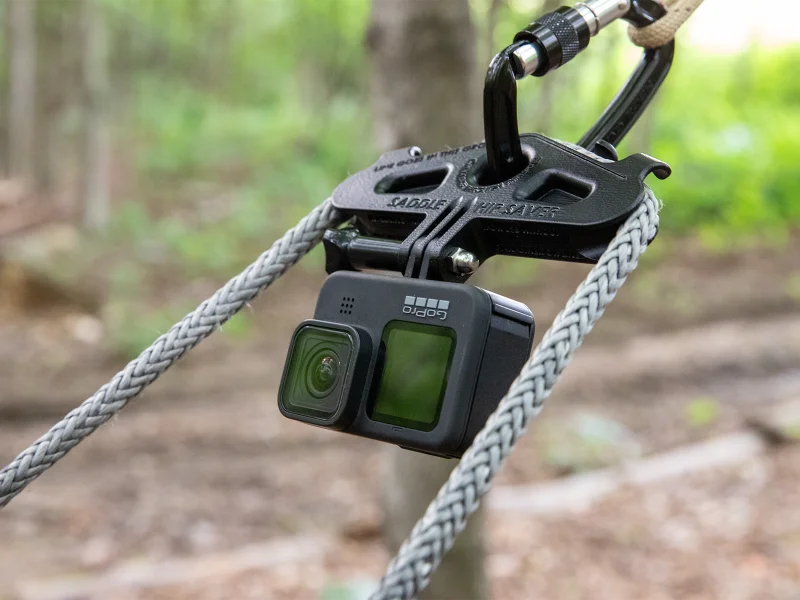
Drop a GoPro or similar into the 2-prong mount and tighten the screw. That connection is mechanical, so it is the setup to run when the footage has to survive drawing, turning, and standing rather than a magnet holding through it.
The days you are in the tree from dark to dark are the days hip pinch decides how long you last. Holding the bridge legs 4.53 in. (115 mm) apart, plus a smooth rope channel that lets you shift and resettle, keeps the bridge from closing back in on you sit after sit.
Checking wind, pulling up a map, or texting your partner means the phone is docked at the carabiner in front of and above you instead of buried under layers. One motion docks it, one motion pockets it, gloves on.
Standing on the platform to stretch used to mean resetting your spreader afterward. The retention ears hold it on the rope through the slack, so you stand, sit, and go back to hunting.
The Guide
Classic vs. GoPro + MagSafe
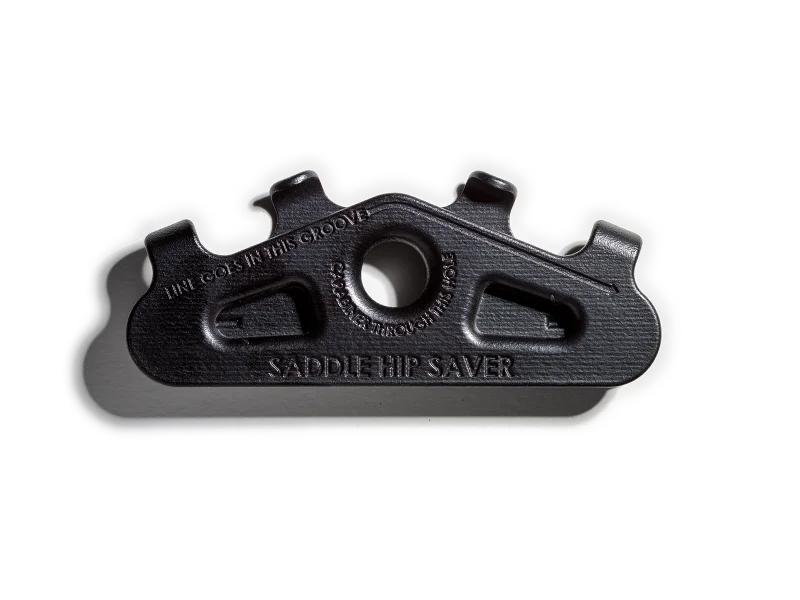
The Classic weighs 1.59 oz (45.2 g) and measures 5.00 x 2.05 x 0.59 in. (127 x 52 x 15 mm), which makes it the lighter of the two by a wide margin. It clips in at the carabiner, holds your two bridge legs 4.53 in. (115 mm) apart so they stop converging on your hips, and then you forget about it. Nothing to aim, nothing to adjust, nothing extra hanging off your rope in the dark.
Here is the whole case for it in one place, because it is worth adding up rather than scanning past. You get a published spread number, which nobody else in this category will give you. You get retention ears that keep the part on the rope when the bridge goes slack. You get a finished surface slick enough that the legs glide instead of binding. You get Nylon 12 built on commercial production equipment, so the part you receive matches the one your buddy received. It is made in Coopersville, West Michigan, and it is covered by a Limited Lifetime warranty. That is the argument. Any one of those on its own is a feature. Together they are the reason this is not the cheapest spreader you can buy.
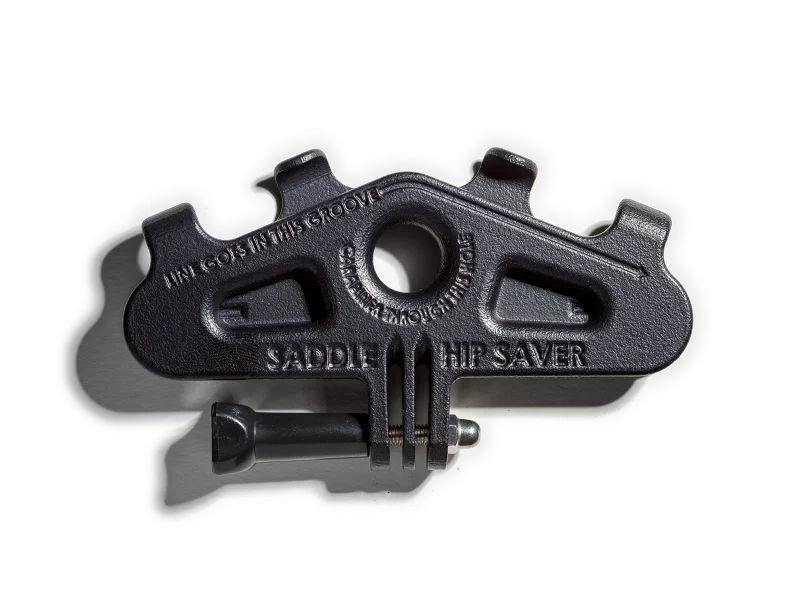
The GoPro + MagSafe is a different piece of gear built on the same body. Assembled with the magnetic plate and the GoPro screw it runs 3.15 oz (89.2 g) at 5.00 x 2.87 x 0.87 in. (127 x 73 x 22 mm). That is close to double the Classic and you should know it going in. The spreader alone is 1.77 oz (50.2 g), and with the GoPro screw and no magnetic plate it is 2.17 oz (61.4 g), so you have some say in how much you carry.
What the extra weight buys is consolidation, and that is the real case for it. One clip instead of two separate purchases. One part on your bridge instead of two competing for the same junction. One thing to inspect, one thing that can fail at height, one thing to find and seat in the dark with cold hands. It is also the one that grips the rope itself through the retention ears rather than hanging off the carabiner, so the camera position stays where you set it. If you are going to run a spreader and a camera mount anyway, carrying that as one part is lighter and simpler than carrying it as two.
Be honest with yourself about whether you film. If you have never filmed a sit and do not plan to, the extra 1.56 oz (44 g) buys you nothing and the Classic is the better purchase. Buy the camera version because you will use the camera, not because it has more on it.
Rope-Retention Ears and Why They Matter
A spreader only works while it is on the rope. The moment you stand up on a platform or a stick, the bridge goes slack, and anything riding loose on that rope can slide off and end up on the ground 25 ft. (7.6 m) below you. The rope-retention ears at the top of both versions fix that. The rope seats into them and they grip the spreader to the rope, so the part stays captured whether the bridge is loaded or completely slack.
This is on both the Classic and the GoPro + MagSafe. It is not a tether, a shock cord, or an accessory you add on. It is part of the printed body, which means there is nothing extra to lose and nothing to re-rig every time you set up.
The Finished Surface, Glide, and Noise
Both versions get a post-process surface finish after they come off the production equipment, and that step is the one you notice in the tree. A rough surface has enough texture to grab a rope, and a spreader that grabs stops sliding right when you want to shift your weight. The finished channel is slick and low friction, so the bridge legs glide through it and the part tracks with you across a sit instead of pinning you into one position.
The same smooth surface quiets the contact between the carabiner and the part. That contact sits at the carabiner just above your head, close enough that squeak and rattle is a real problem in a saddle, and plenty of hunters end up taping their hardware to shut it up. You should not have to fix that yourself with hockey tape.
Nylon 12 handles cold, moisture, UV, and bark contact without getting brittle, and black hides bark stain. Both versions carry a Limited Lifetime warranty.
The Magnetic Phone Dock, Straight
The dock on the GoPro + MagSafe holds MagSafe-compatible phones and Qi2 magnetic phones, including Android phones in a Qi2 magnetic case. It snaps on and off one-handed with gloves and rotates between portrait and landscape. Remember where it sits: up at the carabiner, above you and within easy reach, not down at your waist.
Read this part before you buy, because it decides whether you are happy with the dock. Magnetic hold depends entirely on what is between the magnets. A magnetic-compatible case or a bare phone gives you a strong hold. A thick case, a heavy battery case, or any case without magnets in it will weaken the hold, sometimes a lot. If that is your setup, either swap to a magnetic-compatible case or plan around it. Either way, run a phone leash. You are 25 ft. (7.6 m) up a tree, and a leash costs less than a screen.
Where It Installs and What Fits
Picture your setup. The bridge connects at each hip, both legs run up and meet at a single carabiner, and that carabiner clips to the tether around the tree. The Hip Saver goes right there, at that junction. It never rides across your hips and never contacts your body. It holds the top of the bridge V open so the two legs stop converging and squeezing in on you.
Because it lives at the carabiner and rope connection rather than on the saddle itself, brand does not enter into it. That junction is the same on every saddle setup out there. If you run a bridge and a carabiner, it fits.
Setup takes seconds on the ground. Clip the carabiner through the Hip Saver, seat the rope into the retention ears, and go. Most hunters leave it on the rope permanently so it is ready every time the rope comes out of the pack.
Field manual
Is the Hip Saver load-bearing, and is it safe?
Yes, it is load-bearing. In normal use it carries bridge rope load, and it is built from Nylon 12 on commercial production equipment for that reason. The question underneath this one is usually whether it can drop you if it breaks at height, and the answer is no. Your rope stays captured inside the carabiner at all times, exactly the way it does with no Hip Saver installed at all. The part sits in that junction, it does not replace it, so a failure would cost you your hip comfort and nothing else. That is the honest answer and it is the important one. It is a comfort component rather than rated or certified climbing equipment, so keep inspecting your rope, carabiner, tether, and saddle the way you always have.
Where exactly does the Hip Saver install?
At the carabiner, at the junction where your tether meets your bridge rope. Your saddle bridge connects at each hip and both legs run up to meet at that single carabiner, and the Hip Saver sits at the top of that V. It does not ride across your hips, it does not sit against your body, and it is not a pad. What it does is hold the two bridge legs 4.53 in. (115 mm) apart at the top so they stop converging and squeezing inward on your hips. The relief shows up at your hips, but the part is doing its work up at the carabiner above you.
What is the difference between the Classic and the GoPro + MagSafe?
Both use the same spreader body, hold your two bridge legs the same 4.53 in. (115 mm) apart at the carabiner, have the same rope-retention ears, and carry the same smooth finished surface. The Classic stops there at 1.59 oz (45.2 g) and 5.00 x 2.05 x 0.59 in. (127 x 52 x 15 mm) for $54.99. The GoPro + MagSafe adds an integrated 2-prong action camera mount and a magnetic phone dock, which brings it to 3.15 oz (89.2 g) assembled and 5.00 x 2.87 x 0.87 in. (127 x 73 x 22 mm) for $74.99. If you never film, buy the Classic and put the difference toward something else. If you film or want your phone docked in the tree, the GoPro + MagSafe covers both jobs in one part.
What do the rope-retention ears do?
They keep the spreader on the rope when the rope is not under tension. The two ears sit at the top of the body and the rope seats down into them, where they grip the spreader to the rope. When you stand up on your platform or feed slack into the bridge, the Hip Saver stays captured instead of sliding free and falling. Both versions have them and they are printed as part of the body, so there is no shock cord, tether, or clip to add or replace. It is one less thing to rig and one less thing to lose.
Why does the surface finish matter?
Two reasons, and both show up in the tree. First, glide. A rough surface has enough texture to bind against a rope, and a spreader that binds will not let the bridge legs slide when you shift your weight. The post-process finish leaves the channel slick and low friction, so the rope moves freely through it and the part tracks with you. Second, noise. That smooth surface quiets the contact between your carabiner and the part, so you are not dealing with squeak and rattle at the carabiner just above your head during the exact moments you need to be silent. It is a real manufacturing step with a result you can feel and hear, not a description of a color.
Will it work with my saddle?
Yes. It installs at the carabiner rather than on the saddle itself, and that junction is standardized across saddle setups, so brand does not matter. If your setup has a bridge that meets at a carabiner, the Hip Saver fits. It handles common oval and D-shaped carabiners and standard bridge rope diameters with no modification to any of your gear. As with any accessory you put in that connection, check that your carabiner gate closes and locks cleanly after you clip in and before you leave the ground.
What size rope does it fit?
The rope-retention groove at the top measures approximately 13 mm (0.51 in.) and the main channel runs approximately 17 mm (0.67 in.) deep, and those numbers are the same on the Classic and the GoPro + MagSafe. That covers the bridge and lineman ropes saddle hunters actually run, including spliced hollow-braid setups. Treat these as approximate fit dimensions rather than a rated maximum, since rope diameter varies between manufacturers and a spliced or worn section measures differently than the tag says. If your bridge sits near the top of that range, measure it before you order. The rope should seat into the ears and slide freely in the channel without having to be forced.
Which cameras fit the 2-prong mount?
The 2-prong interface on the GoPro + MagSafe is the standard action camera pattern, so GoPro Hero cameras and the many third-party action cameras built to that same standard will mount to it. If your camera already works on a standard 2-prong mount, it works here. The mount is part of the spreader body rather than a bolt-on, so it stays low profile and does not add a new snag point when there is no camera on it. Check your camera's own mounting tabs or adapter against a standard 2-prong before you climb.
How well does the magnetic dock hold my phone?
It holds well with a bare phone or a magnetic-compatible case, and it works with MagSafe-compatible iPhones and Qi2 magnetic phones, including Android phones in a Qi2 magnetic case. Magnet strength drops fast with distance, so the honest answer is that a thick case or a case with no magnets in it will noticeably weaken the hold, and a heavy battery case is the worst combination of both. If that is your setup, switch to a magnetic-compatible case or a bare phone. Regardless of case, run a phone leash when you are docking a phone in a tree. The dock is meant to be convenient, not to be the only thing between your phone and the ground.
How much weight does the camera version really add?
Assembled with the magnetic plate and the GoPro screw, the GoPro + MagSafe is 3.15 oz (89.2 g) against the Classic's 1.59 oz (45.2 g), so it is close to double. The spreader body by itself is 1.77 oz (50.2 g), and with the GoPro screw installed but no magnetic plate it is 2.17 oz (61.4 g). None of these are heavy in absolute terms, but if hip comfort is all you are after, there is no reason to carry the extra. Buy the Classic in that case. The weight is only worth it if the camera or phone mount is something you will actually use.